

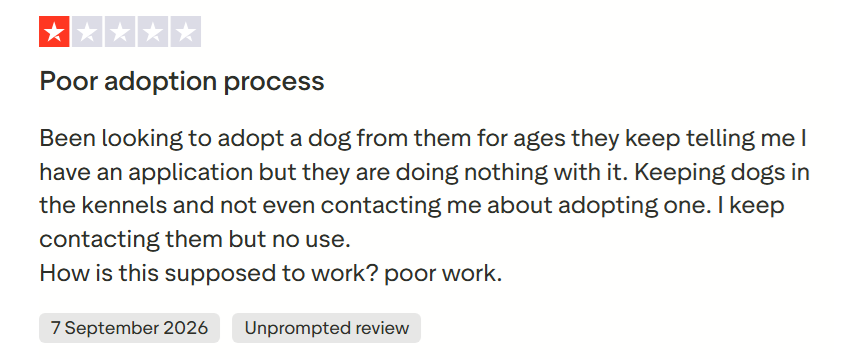
Look up pretty much any animal rescue charity on Trustpilot and you’ll find a review similar to the one above. A potential adopter has a valid gripe about the lack of response to their online rehoming application, when that same rescue is regularly publicising that it’s overrun with animals in desperate need of a home.
It’s an understandable reaction, and it points to a common problem that many rehoming charities face. How do you balance the need for an engaged online audience with the day‑to‑day running of a busy centre?
Even in larger, relatively well‑resourced organisations, the backlog of enquiries from potential adopters is sometimes greater than the rehoming team has capacity to work through. An effective advertising campaign or news story can leave busy staff triaging dozens of new applications. Under pressure, they may decide to cherry‑pick the ones that best suit their harder‑to‑rehome animals, such as homes with no kids, no other pets, or experience of managing problem behaviours. This inevitably means that applicants who are less likely to be a suitable match quickly drop down the list of people requiring a call or email back.
For anyone building a career in animal rescue, understanding the challenges and opportunities that online rehoming and social media bring to the sector is vital. Looking ahead to how AI might reshape this work is arguably even more important.
The early days of online rehoming
In the late 00s, I oversaw rehoming at Battersea Dogs & Cats Home when it became one of the first UK rescues to introduce online applications. Most large animal rescue organisations had been online since the end of the 90s, but allowing potential adopters to apply directly via the website was new, as was social media, which had only just started to gain traction. Without any data or insight on what to expect, we significantly underestimated how popular it would be. Applications doubled almost overnight, growing from around 10,000 to nearly 20,000 in the first full year.
The new geographical reach it provided was undeniable. The rural homes we so desperately needed at our London site could now submit their details quickly and easily from anywhere in the UK. But with that came other unexpected challenges. Where prospective owners once had to travel to one of our three sites in person to apply, now they could submit an initial application on a whim. Inevitably, that meant not everyone had fully considered what taking on a dog or cat actually involved.
Every weekend, we’d receive a glut of applications in the early hours of the morning, sometimes from individuals who had no recollection of submitting them when we called a few days later. Others would turn up at a centre to collect a cat or dog, assuming they’d already reserved it online and had nothing more to do. That’s how it works at Argos, so why not here? The extra workload also meant that many applicants never got a response, loving homes lost in an avalanche of applications the rehoming team was struggling to wade through.
How online rehoming looks today
The way in which rescues rehome animals has evolved steadily over the last 15 years, particularly in organisations that have been able to invest in their digital infrastructure. Websites and rehoming policies are often now designed to manage expectations and discourage impulse applications. Dogs Trust, for example, asks prospective owners not to apply for a specific dog but to describe what they’re looking for, so staff can suggest suitable matches.
Online rehoming applications can be linked directly to databases to reduce the need for manual transfer of information. Analytics and social media content are used to steer people toward animals that may not be getting the interest they deserve. Approaches like this make the process smoother and more efficient, but as the numerous one‑star reviews demonstrate, it’s still not perfect, particularly if the charity you work for is operating on a shoestring budget.
The benefits of an engaging website usually outweigh the drawbacks, but for staff on the ground, it so often comes down to time. Time to take a photo, or help whoever’s doing it; time to write a compelling profile or film a clip. Time to deal with the enquiry from someone you know isn’t really going to rehome the cat they’ve emailed about. Time to field 100 calls about a cute young puppy when you know the old grey staffie is the one who really needs promoting. It’s perhaps for this reason that some rescues choose not to rely on a website at all.
The risk of being left behind
Around a quarter of the 166 rescues affiliated with the Association of Dogs and Cats Homes do not currently have an application function built into their site, with 8 relying on Facebook in lieu of any website at all. Across the board, there are also examples of sites that aren’t fully functional, with broken links and out-of-date information. This is in no way a criticism. They all have their own processes and do amazing work finding homes for the animals in their care. But for underfunded rescues, whose sole focus is the day‑to‑day care of their animals, there is a real risk they’ll be left behind over the next decade. Here’s why:
- Evolving demographics. The largest single group of dog owners in the UK falls into the 45–64 age bracket, a demographic that’s still well represented on Facebook. But Facebook usage among Gen Z falls year on year, in favour of Instagram and TikTok. Stick with what’s comfortable for long enough, and a rescue risks losing touch with the next generation of adopters and donors before it’s even noticed the shift.
- Changing regulation. Under‑16s will be banned from using social media entirely from spring 2027 under the Online Safety Act. With the minimum age to adopt a dog set at 18 by most rescues, this is unlikely to have a direct impact on rehoming itself, but charities are going to have to find other ways to build brand awareness among the supporters of the future.
- Getting found at all. A rescue without a modern, functional website isn’t just missing out on applications; it’s invisible to anyone searching online for somewhere to adopt from. Relying on Facebook alone means relying entirely on people who already follow the page, rather than being found by people who don’t yet know the rescue exists.
The impact of AI
AI is impossible to avoid at the moment: it’s in the news, in every industry’s future plans, and no one really knows how it’s going to play out. What we can be sure of is that organisations which are already some way behind the curve when it comes to online activity may find themselves falling even further behind over the next few years.
On the opportunity side, the application backlog I described earlier is precisely what a new wave of AI tools is being built to solve. AI platforms are now producing agents that screen multiple online rehoming applications automatically, designed to lighten the administrative workload that so many organisations struggle with. It only works, though, if a rescue already has a website generating applications to screen in the first place, which puts it out of reach for the organisations most likely to benefit from it. None of this is mainstream in UK rescue yet, and a provider’s own marketing claims aren’t the same as a rescue proving it works in practice. But if it delivers even part of what’s promised, it’s a direct answer to the workload problem. What it isn’t is a replacement for the human judgement that decides whether a home is actually right. Whether a dog and an owner will suit each other isn’t something you can assess through a form, and no amount of AI changes that. What it can do is clear away enough of the admin to free staff up for the hands-on work that still needs a person. AI can’t walk a dog.
The risks associated with AI are worth mentioning too. An online presence that isn’t actively managed can be exploited. In February 2026, fraudulent Facebook pages posted AI-generated photos of shelter dogs, falsely claiming they faced imminent euthanasia to drive donations, and a similar scam aimed at a Californian shelter generated hundreds of distressed calls from people who believed it, pulling staff time away from the animals actually waiting to be rehomed. Some charities are having to defend genuine content too. When the RSPCA shared a photo of over 250 rescued dogs in April 2026, they had to publicly insist, “This photo is not AI, it’s real.” Neither problem is going away on its own.
Opportunities for organisations and those starting out in the sector
There’s real potential here, both for organisations and for the people building a career in animal rescue. Tech‑savvy people with web design and content skills have a chance to shape how a rescue reaches potential adopters and manages its applications, work that most underfunded rescues know they need but don’t have the resources to do well.
Going online isn’t optional anymore, and the reach it gives even a small, local rescue is significant. So, if you’re stepping into a more public-facing operational role, it’s worth knowing what the opportunity actually involves. It means time spent creating content, fielding enquiries that may never amount to anything, and the occasional bit of criticism that has nothing to do with how well you’re doing your job. Build that into how you plan your week and how you interpret your feedback, and it stops being a surprise.
More reach doesn’t automatically mean more homes, and the workload it creates is easy to underestimate. But get the online process right, and the additional reach it gives you becomes more than just extra admin. It starts doing what it’s actually there for, putting harder-to-place animals in front of people who’d never otherwise have come across them. That’s the real opportunity here, more animals finding the right home, faster, not just more applications to work through.
Further reading
Charity Digital Skills Report 2026: AI use hits 79% as funders urged to act fast – fundraising.co.uk