

With the school summer holidays in full swing, I recently took my kids to see Paw Patrol: The Dino Movie. It’s probably a poor reflection on my ability to just switch off for 90 minutes, but somewhere between the popcorn and the rescue pups’ dramatic escape from an erupting volcano, my attention started to drift. First, I found myself working out each pup’s breed, before starting to ponder what health issues each one might face.
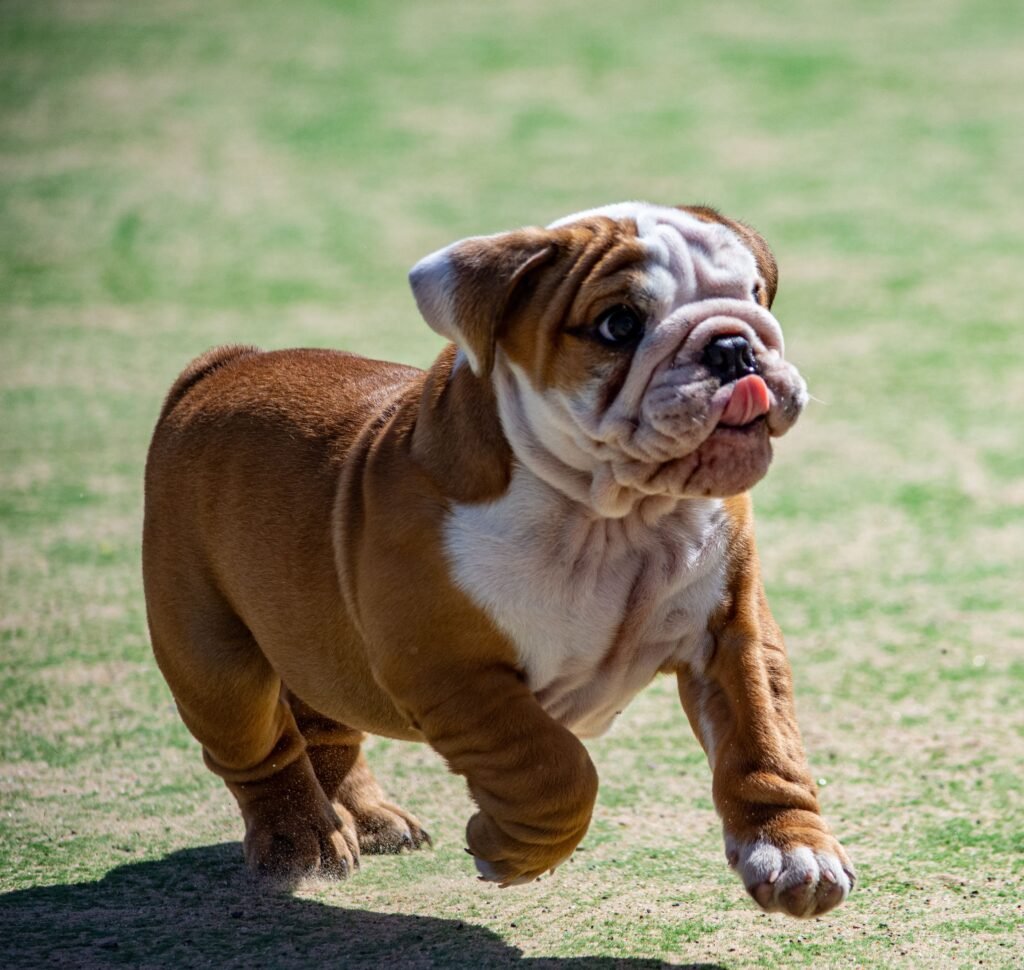
Rubble, the team’s English Bulldog, was the one that stayed with me. In real life, a brachycephalic (flat-faced) dog like Rubble may struggle to breathe, even with minimal exercise or in mild heat. Running away from a river of lava would be another matter entirely. It’s a small, slightly silly observation, but it speaks to a more serious issue that vets and welfare organisations have been working hard to address: extreme conformation, and what to do about it.
The scale of the problem
“Conformation” simply means a dog’s physical shape and structure. It becomes a welfare issue when that shape is bred to an extreme for appearance’s sake. The cost is the dog’s ability to do ordinary things like breathe, blink, sleep, exercise, or give birth without medical intervention.
The RVC’s VetCompass programme found that more than 25% of the 2.25 million dogs it recorded in 2019 showed at least one extreme-conformation trait: brachycephaly, excessively shortened legs, or a shortened or absent tail. A 2024 Dogs Trust study found that over 20% of UK dogs come from a flat-faced breed. Rubble is not alone.
APGAW, the All-Party Parliamentary Group for Animal Welfare, has described extreme conformation as one of the most significant welfare problems facing companion animals in the UK today.
What the Innate Health Assessment does
In November 2025, APGAW launched the Innate Health Assessment (IHA), a free, ten-point visual checklist. Professor Dan O’Neill of the Royal Veterinary College developed it, building on 15 years of VetCompass research.
Anyone can use it, breeders, local-authority licensing officers and prospective owners, without specialist training, equipment or a vet’s involvement.
It is designed to be used by anyone, breeders, local-authority licensing officers and prospective owners, without specialist training, equipment or a vet’s involvement.
The IHA assesses a dog against ten visible conformational criteria. These include whether its tail is long enough to wag, and whether its muzzle is long enough to breathe comfortably. Its eyes, skin and legs are also checked against a healthy range for normal function. A dog must pass at least eight of the ten criteria to be considered suitable for breeding or a suitable choice for a prospective owner.
The tool has real backing too, with the British Veterinary Association, the RVC, the RSPCA, Dogs Trust, Battersea, Blue Cross and PDSA among the more than 20 organisations that have endorsed it.
The RSPCA’s Ashleigh Brown, Scientific and Policy Manager in its Companion Animal Department, said the tool gives owners and breeders the means to make better-informed decisions, describing the launch as an important first step. The longer-term aim, she said, is to incorporate this kind of assessment into breeder-licensing processes.
Local authorities already have a duty to consider this. Under the Animal Welfare (Licensing of Activities Involving Animals) (England) Regulations 2018, they must assess whether breeding could reasonably be expected to have a detrimental effect on the health or welfare of offspring. The IHA could give inspectors and vets a more consistent, evidence-led basis for making that judgement, rather than relying solely on individual professional opinion.
The “67 breeds banned” claim
The IHA’s launch was quickly followed by headlines claiming that 67 popular breeds, including corgis and dachshunds, could be “banned” as a result. PETA published its own version of the claim, arguing that making the IHA mandatory “would be an excellent first step” towards ending breeding it opposes. Tabloids and lifestyle sites ran with the story soon after.
APGAW and several of the IHA’s supporting organisations, including PDSA, responded that this was a misreading of the tool. Marisa Heath, APGAW’s director, put it plainly:
“There were some quite clickbait headlines about banning 67 breeds, which is completely false. We’ve run those breeds through the IHA and they pass, some with fails, but they pass nonetheless.”
The IHA does not discriminate by breed. It assesses the individual dog in front of you.
The aim is not to declare an entire breed inherently unacceptable; it is to identify individual dogs whose visible physical features suggest that breeding from them could perpetuate avoidable health and welfare problems.
Why full sector buy-in matters
One notable absence from the IHA’s list of formal supporters is the Royal Kennel Club. That’s not to say that they have been left out of the process though. APGAW has stated that breeders and the RKC were both involved in developing the tool, and the two organisations have an ongoing working relationship, including a planned meeting with a breeders’ working group. What the RKC hasn’t done is adopt the IHA as its own assessment.
Instead, the RKC is developing a separate tool as part of its new Breeding for Health Framework. This launched following a 2025 review in which the RKC consulted breeders, Breed Health Co-ordinators, vets, geneticists, and welfare campaigners. The Nose-to-Tail Veterinary Visual Assessment is one of three priorities to come out of that process, alongside work on genetic diversity and testable health conditions. It’s a veterinary-led scoring system that grades multiple conformation criteria on a 0-3 scale. These are then combined into a total score, intended to allow comparison between individual dogs and help track breed averages over time.
It is a different methodology from the IHA’s simpler pass/fail structure, and it is also at a considerably earlier stage. At present, it is not publicly available. The RKC has been previewing it to a limited number of owners through an introductory video and feedback assessment, with trial runs at a small number of breed shows as part of its development.
APGAW, for its part, has struck a notably diplomatic tone about this. It describes the IHA as “just one tool in a potential toolbox of other solutions” and welcomes other initiatives addressing the same problem. Two credible organisations, both working from an evidence base and both concerned with the same underlying welfare issue, are nonetheless developing two separate tools. That is a reasonable illustration of how difficult full sector-wide agreement can be, even where there is broad acceptance that a problem exists and consultation has taken place.
The RKC sits at the centre of pedigree breeding and showing, and this is exactly the community that any conformation assessment needs to reach. Its decision to develop its own tool rather than adopt the IHA outright is therefore worth watching. Whether the two approaches eventually align, one becomes dominant, or both continue in parallel may shape how quickly meaningful change reaches breed rings and breeding programmes.
What it means in practice
For people working in veterinary practice, rescue or licensing, this is operational rather than theoretical.
Breeder licensing. The IHA could give local-authority inspectors and accompanying vets a standardised, defensible basis for making the conformation judgement already required under the 2018 Regulations, rather than relying solely on a subjective call.
Rehoming and owner advice. It is a useful tool to put in front of a prospective owner who has fallen for a particular look without fully considering what that look means for the dog’s everyday comfort.
Breeder support. The tool is designed to encourage gradual change, longer muzzles, fewer skin folds and less prominent eyes, without requiring people to abandon a breed to which they are committed.
Health testing. The IHA complements rather than replaces existing breed-specific health testing. Hip scoring, eye testing and DNA screening for known inherited conditions all still matter. The IHA addresses visible structural welfare issues that those tests do not necessarily capture.
Back to the cartoon dogs
None of this is a criticism of Paw Patrol, or of Rubble, who do great work keeping the citizens of Adventure Bay safe. But he is a useful illustration of the gap the IHA exists to close. An appealing look, played for warmth and comedy on screen, would likely fail a straightforward ten-point visual check in real life.
Popular films and television shows can drive demand for the breeds they feature. Rubble is exactly the kind of character who could make a Bulldog puppy feel like the obvious choice for a family who’s just watched the film. That makes this a conversation worth being ready to have, clearly and calmly, in a consulting room, a rehoming conversation or a breeder inspection.
If you’re curious how it works, it only takes a couple of minutes to try.