

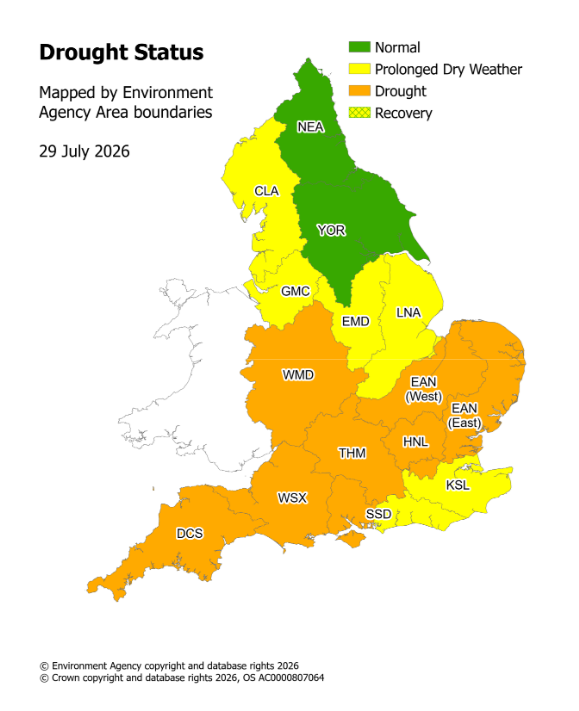
Climate change is reshaping the animal sector. The Met office has confirmed July 2026 as the driest July on record for both England and Wales. The Environment Agency has declared drought across half of England, and Natural Resources Wales across all of Wales, the third drought in five years for some regions.
Just five months earlier, in February, other parts of England were dealing with the opposite problem. Continuous rainfall had left ground so waterlogged that one Northamptonshire farmer described his fields as “almost fit for growing rice.”
Drought in July. Flooding in February. Both in the same year.
This isn’t a story about one bad summer; it’s a pattern we’re now seeing repeatedly. The AHDB lists both flooding and drought as recognised, ongoing risks to UK agriculture. Climate change is rapidly becoming a factor in all areas of the animal sector, and for anyone building a career with animals, it’s worth considering how these patterns may affect you in the long term.
The obvious impacts
Anyone working directly with animals will already be familiar with some of the challenges associated with climate change.
In a drought, animals need more water, and grazing land often can’t provide enough forage without careful management. Heatstroke risk rises sharply in extreme temperatures, a genuine danger for animals in outdoor enclosures, on yards, or without easy access to shade and cool water.
Waterlogged fields and contaminated flood water put livestock at risk of illness, or worse. Wildfire risk rises in dry conditions on land where animals graze or roam.
The less obvious impacts are the ones that only become clear if you look a little further ahead.
Visitor Attractions
Extreme heat doesn’t just affect animals directly, it affects whether the public can come and see them at all. During the red heat warnings of June 2026, many zoos and farm parks shut early or closed entirely, prioritising animal and staff welfare over opening hours. Similar closures happened during comparable heatwaves in 2022.
These are the right calls for animal welfare, and very few working in the sector would argue otherwise. But zoos, farm parks, and wildlife attractions rely heavily on visitor income. Repeated, unplanned closures during peak summer season are a real cost, particularly for smaller zoos or farm parks. As heatwaves become more frequent rather than rarer, it’s reasonable to ask what that means for an attraction’s finances over several consecutive summers, and in turn, for the job security of the people employed there. This connection doesn’t appear to have been studied directly, but it’s worth keeping an eye on.
A growing threat to native wildlife
There’s a wildlife-specific risk too, one that’s already becoming a bigger part of conservation work.
Government-linked risk assessments identify invasive non-native species as a priority climate risk to UK wildlife. Warmer winters and increased flooding make it easier for species that couldn’t previously survive here to establish themselves. Once established, they often out-compete or prey on native wildlife that has no natural defence against them. The Asian hornet, which preys on pollinators, and pink salmon, now recorded in rivers in Scotland and northern England, are both on the UK’s current watchlist as species of growing concern.
For conservation and wildlife roles specifically, this is already a visible shift, invasive species monitoring, control, and biosecurity work is a growing part of the job, not a niche specialism. Anyone building a career in this space is likely to find it becomes a bigger part of the role over time, not a smaller one.
Work that isn’t built to flex
What’s talked about less is what unpredictable weather does to the things already underway.
A lot of fixed-term conservation roles are advertised, habitat restoration, conservation grazing schemes, planting programmes. Very few mention any contingency for weather disruption to the work itself. These projects are often planned around a normal year: a wet winter to establish new planting, typical grass growth for a grazing scheme, a dry enough summer to access certain land. When the weather doesn’t cooperate, in either direction, that plan doesn’t pause cleanly. It adapts, gets delayed, or in some cases loses progress that took years to build.
If you’re taking on a 6 or 12-month contract built around a specific piece of fieldwork, it’s worth knowing what happens to that contract, and to your employment, if conditions disrupt the timeline.
Scheduling, and who it affects
Another notable impact is already playing out in many kennel and rescue environments.
In extreme heat, dogs often need to be walked and exercised earlier in the day, before it gets too hot for them to do so safely. That’s a sensible, welfare-led decision. But it also means a working day that starts significantly earlier than usual, sometimes with little notice.
That’s a reasonable operational response to the weather. What’s less clear is how it’s factored in for staff, particularly anyone balancing the job with childcare or other caring responsibilities. Is it a genuine, planned shift change, or is it just quietly expected, absorbed by whoever happens to be on shift that day?
Why this is worth thinking about now, not later
None of this means these are bad careers to choose, they aren’t, but they’re roles worth going into with your eyes open. A few things worth considering now, so you’re prepared for increasingly extreme weather, whatever corner of the sector you’re looking at:
- Is there a contingency plan if weather disrupts the project timeline, and how would that affect the role or contract?
- Has the organisation had to change working patterns in response to extreme weather before, and if so, how was that communicated and managed for staff?
- Is flexibility around early starts or schedule changes factored into pay, time off in lieu, or rota planning, or treated as an unpaid inconvenience?
- For roles with a caring responsibility angle, is there flexibility for staff who can’t easily shift their hours at short notice?
- For conservation and wildlife roles specifically, is invasive species work part of the role now, or expected to become a bigger part of it over time?
Climate change and the animal sector: a pattern, not a one-off
Drought and flooding in the same year isn’t a fluke, and neither is a rising number of new species establishing themselves in UK habitats. This is the shape of the environment the animal sector now operates in, and it’s reasonable to expect more of it, not less.
For anyone building a long-term career with animals, whether on the land, in a kennel block, behind the scenes at a zoo, or out in the field on a conservation project, it’s worth treating that unpredictability as a normal part of the job to plan for, not an exception you hope to avoid.